




The Reinforced Concrete cast-in-situ lintel is an AutoCAD addon that automates the lintel drawing, lintel tags, lintel schedules, and lintel quantity takeoff.

The minimum concrete cover for beams depends on environmental factors. According to ACI 318, you need at least 40 mm (1.5") of cover for weather-exposed or ground-contact surfaces. For protected surfaces, the minimum is 20 mm (3/4"). Eurocode 2 requires between 25 mm and 40 mm, depending on exposure class, bar size, and fire rating needs. Use durable plastic spacers to keep bars in place. Place spacers about 1.0 m apart along the beam. These maintain correct cover during pouring and curing. Avoid steel spacers; they can corrode and reduce durability over time. Concrete cover not only protects the reinforcement from corrosion but also ensures proper bond strength between the bars and surrounding concrete. Insufficient cover can lead to premature deterioration, reduced structural performance, and failure to meet durability requirements specified in international standards.
The minimum concrete cover for columns varies with exposure conditions. ACI 318 requires at least 40 mm (1.5") of cover for bars exposed to weather or soil. In dry, protected locations, the minimum reduces to 20 mm (3/4"). Eurocode 2 recommends between 25 mm and 50 mm, depending on exposure class, bar size, and required fire resistance. To maintain proper cover, place non-corrosive plastic spacers vertically along the column reinforcement. For example, they are typically spaced every 1.0 m or near bar intersections. This helps hold the reinforcement in position during concrete placement. Avoid steel spacers, as they may rust and reduce long-term durability. Concrete cover serves multiple roles. It protects the reinforcement from corrosion and enhances the bond between steel and concrete. In addition, it helps resist fire and maintain structural capacity. Therefore, insufficient cover can lead to durability issues and failure to comply with code requirements.
The foundations minimum concrete cover values depend on how the reinforcement is placed. For instance, ACI 318 specifies a minimum of 75 mm (3") when concrete is cast directly against soil. However, when cast against formwork, this requirement is reduced to 40 mm (1.5"). Similarly, Eurocode 2 sets cover values between 30 mm and 50 mm, depending on exposure class, bar diameter, and required fire resistance. To maintain proper cover, place durable plastic spacers under bottom bars and along vertical edges. For example, spacers should be positioned every 1.0 m and at key points such as corners and near column dowels. In contrast, avoid using steel chairs, since they may corrode over time and reduce the protective cover’s effectiveness. Concrete cover plays a critical role in foundation performance. It prevents direct contact between reinforcement and aggressive soil, thereby reducing the risk of corrosion. In addition, adequate cover improves anchorage, enhances long-term durability, and supports structural integrity. Therefore, using the correct cover depth is not only a good practice—it is essential for code compliance and service life.
The minimum concrete cover for shear walls depends on the environmental exposure and reinforcement position. According to ACI 318, reinforcement exposed to weather or soil requires at least 40 mm (1.5") of cover. In protected interior conditions, the minimum reduces to 20 mm (3/4"). On the other hand, Eurocode 2 recommends cover values ranging from 25 mm to 50 mm, depending on exposure class, bar size, and fire resistance rating. To maintain consistent cover, engineers typically use non-corrosive plastic spacers along both faces of the wall. For example, placing them every 1.0 m and near openings or corners ensures proper bar alignment during concrete pouring. Steel spacers, however, should be avoided because they may corrode and compromise durability over time. Concrete cover in shear walls provides multiple benefits. Not only does it protect reinforcement from corrosion, but it also ensures adequate bonding between steel and concrete. In addition, it improves fire resistance and structural stability under seismic or wind loads. Therefore, using the correct cover values is essential for both safety and code compliance.

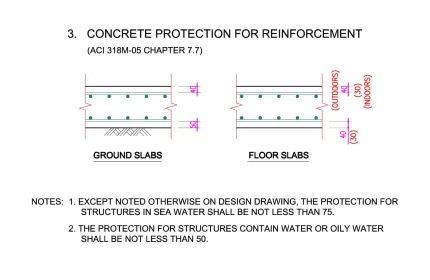
The minimum concrete cover for slabs usually ranges between 20 mm and 30 mm, depending on exposure class. Eurocode allows 20 mm for internal dry environments (XC1), while 30 mm or more is required for external or aggressive exposures like XC3–XC4 or XD classes. According to ACI 318, 20 mm (3/4") is used for interior concrete, and 40 mm (1.5") for concrete exposed to weather or ground. To maintain correct cover, use non-corrosive plastic spacers placed at regular intervals, typically around 1.0 m. These support the reinforcement during casting and curing. Steel spacers are not recommended due to corrosion risks that can reduce durability.
The minimum rebar spacing for slabs depends on bar diameter, concrete aggregate size, and the layer arrangement. According to ACI 318, clear spacing should not be less than the greatest of: 25 mm, the bar diameter, or 1.33 times the maximum aggregate size. Similarly, Eurocode 2 requires spacing of at least the greater of: 20 mm, the bar diameter, or the maximum aggregate size plus 5 mm. These values apply to both the main and distribution reinforcement layers. To maintain code-compliant spacing, ensure proper rebar layout in both directions and between layers. For example, use consistent bar spacing based on slab thickness and bar size. Maintain clear horizontal gaps and vertical distance between layers to allow concrete to flow properly. In addition, be sure to avoid bar congestion near slab edges and openings. Correct rebar spacing allows full concrete compaction, minimizes voids, and improves structural performance. It also helps prevent cracking and ensures load transfer across the slab. Therefore, following minimum spacing rules is essential for durability, serviceability, and compliance with structural codes.


The Reinforced Concrete Rectangular Column is an Autolisp that collects similar columns, adds column tags, column schedules, and measuring quantity takeoff.
Download Free Structural Detail Drawings and Facilitate Quantity Takeoff
Accessing high-quality and standard structural detail drawings and quantity takeoff resources is essential for engineers, architects, and construction professionals. At AppisCAD, we offer a comprehensive library of free resources to enhance your design process and streamline your workflow.
Extensive Library of Structural Detail Drawings
Our collection features a wide range of structural detail drawings, including beams, columns, foundations, and other structural components. These drawings are available in various views such as plan, elevation, and section views, ensuring versatility for any project. Whether you need designs for residential, commercial, or industrial buildings, our library has you covered. All elements adhere to industry standards, ensuring accuracy and consistency in your designs.
Benefits of Using Our Structural Resources
Using our structural detail drawings and quantity takeoff resources ensures consistency and accuracy in your designs. These resources save time and reduce errors in the drafting process. Our high-quality DWG files are ready to use and integrate seamlessly into your AutoCAD projects.
Facilitating Quantity Takeoff
Quantity takeoff is a critical step in construction project management, involving the calculation of material quantities needed for a project. Our tools and resources automate and simplify this process, helping you quickly extract quantities from your drawings and ensuring accurate and efficient material estimation.
How to Use Our Structural Resources
Integrating our structural detail drawings into your AutoCAD drawings is simple. Download the desired drawings, open your AutoCAD software, and insert them into your drawing. You can then move, rotate, and scale the drawings as needed to fit your design requirements.
Download and Get Started
All our structural detail drawings and quantity takeoff resources are available for free download. Visit our product category page, select the resources you need, and download them directly to your computer. Enhance your design projects with our accurate and high-quality resources today!
Explore more resources and tools to enhance your structural design projects: